What would you build differently for 2039?
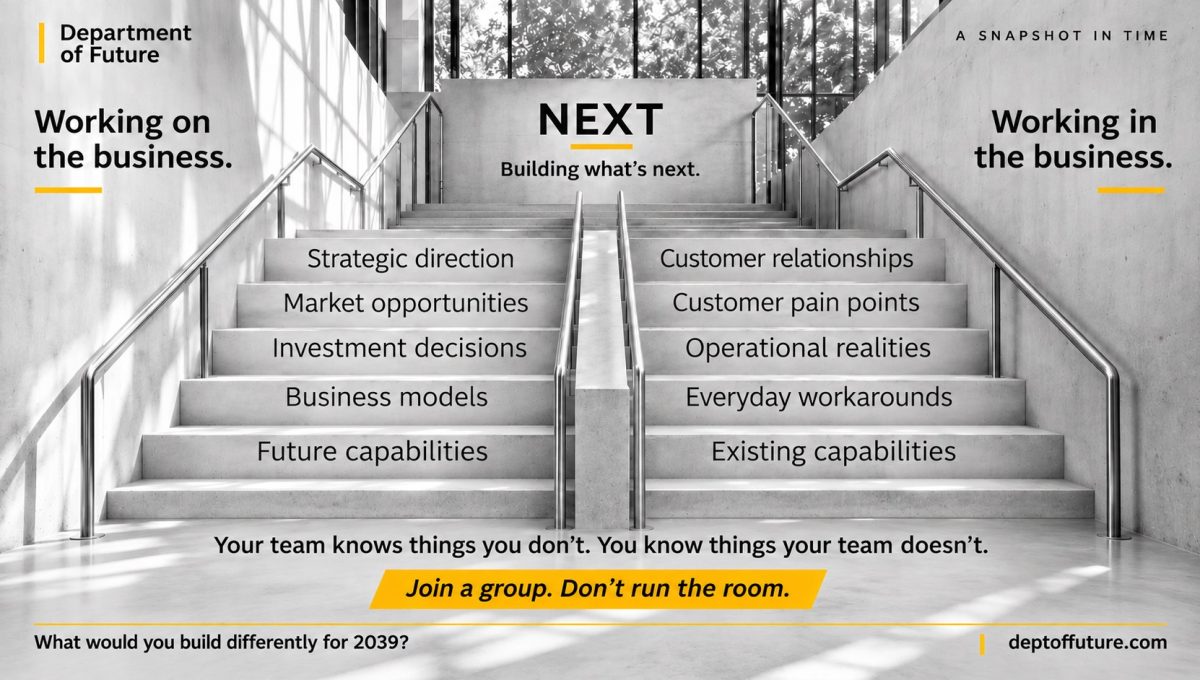
If you lead a team, or sit on a leadership team, this is an activity for you and your people, all in the same room. It takes one thing you’re building and looks at it then, now and next. First, how I got here.
Grand Theft Auto first came out in 1997 and there have been plenty of releases since. The last big one, Grand Theft Auto V, was in 2013, and Grand Theft Auto VI arrived this week. Thirteen years between those two got me looking at what the world looked like back then. It was a very different one.
The iPhone 5s had just come out, working from home was the exception, and Slack, Teams, TikTok and ChatGPT were all still to come. Zoom had only just launched and most offices still ran on desktops, their own servers and paper.
| Worldwide | 2013 | 2026 |
|---|---|---|
| People online | 2.7 billion (39%) | 6.3 billion (76%) |
| Global games market | US$70.4 billion | US$213.9 billion (forecast) |
| People playing games | 1.2 billion | 3.7 billion (forecast) |
| Global cinema box office | US$35.9 billion | US$35.7 billion (forecast) |
Figures are from the ITU, Newzoo, the MPAA and Gower Street Analytics. The 2026 figures are forecasts and the dollar amounts aren’t adjusted for inflation.
A product from the past
All of that reminded me of an activity I designed back in the day when I was teaching. I wanted my students thinking about customers, innovation and marketing.
I asked them to choose a product from the past that no longer existed and bring it back into the world they lived in. Who would the customer be? What problem would it solve for them? How would they market it? What technology would they add, and what would the roadmap look like from there?
It was never about bringing an old product back to life. It was about seeing that a product only makes sense in the world it’s made for.
Room to think differently
For a company, an activity like this is a break from the usual planning, where we look at where we are today and ask where we’ll be in three or five years and where our customers will be. That starts from today and draws a straight line forward, and nobody in the room comes out with a new thought.
This starts somewhere else. Looking back at then reminds everyone how much changed that nobody planned for, and it’s hard to draw a straight line after that. It’s also closer to play than to planning, and people engage differently when they’re part of what’s happening.
Spoiler alert. As the owner, the executive or the manager, you’re not the one with all the know-how and all the answers about your business and your products.
There’s a saying about whether you spend your time working on the business or in it. As a leader you’re meant to be working on it, while your team works in it. So where do those two worlds meet?
They can meet in an activity like this, because your team knows then and now better than you do. They’re in it every day. You’re thinking about next. Put everyone in the same room, working through the same three points in time, and you get a next that neither of you would have reached alone.
Then, now and next
Here’s a version you can try with your team. Pick one thing and look at it at three points in time.
- Then. What did it look like?
- Now. What does it look like today?
- Next. What would it look like in 2039?
At each point, ask the same four questions:
- Who decides to buy it?
- What can the customer now do for themselves?
- Who could build this now that couldn’t before?
- What do the people working in the business see that the people working on it don’t? And the other way around?
Finish with one more question. What stayed the same the whole way through?
Take the cassette tape.
- Then: you bought an album, or you recorded a mixtape for someone. You found it in a record shop or heard it on the radio
- Now: streaming. Every song ever made, and it finds you, through a free trial and a playlist made for you
- Next: over to you
Here’s an example to get you started. Make your own, with rows that are specific to your business.
How to run it
You don’t need much. Something to write on and a group willing to have a go.
There are two ways to move through it:
- Straight through. Start with then, move to now and finish on next
- Figure 8. Start with now, loop back to then, and fast forward to next
The order changes the conversation, and it can change where you end up.
With your leaders and your team in the same room:
- Mix the groups, so leaders and the people who work in the business sit at the same table
- Pick one thing you’re building or investing in this year. It could be a product, a service, a system or a role
- Then: what did it look like 13 years ago, if it existed at all, and who decided to buy it?
- Now: who decides today, what can they do for themselves, and who else could build it?
- Next: who decides in 2039, and what will they still need you for? Don’t assume today’s customer comes with you, or today’s way of finding them
- Agree on one thing you’d do differently this year because of that
If you own the business or lead the team, join a group. Don’t run the room. That means letting your people share and lead. It’s not the time for you to be the leader. If you do this regularly and make sure you’re part of the room, you’ll be humbled, and you’ll learn more about yourself, your team, your business and how to connect with your customers, now and next.
On your own:
- Run it on your own work. What did my job look like then, what does it look like now, and what’s next?
- What would I start learning this year because of that?
At Department of Future we work with deep tech every day. We also challenge our own thinking, because technology is never only about the tech. It’s about the people it’s for and what it changes for them.
We can’t know what 2039 looks like, any more than we could have described today from 2013. But we can ask what we’d build differently if we were building for it.
If your organisation is figuring out where AI and other technology fit in your teams, and where they don’t, this is some of the work we do at Department of Future.
There’s also a longer version of this activity for when you have several teams in the room. For either, you can reach us at hello@deptoffuture.com.
A snapshot in time is an occasional Department of Future series. We take one moment and look at it then, now and next.
Sources
- ITU, The World in 2013: ICT Facts and Figures
- ITU Facts and Figures 2026
- Newzoo 2013 Global Games Market Report, via Game Developer
- Newzoo 2026 forecast, via GamesBeat
- MPAA Theatrical Market Statistics 2013
- Gower Street Analytics 2026 box office forecast
(By Brenda Frisk, Department of Future)